Monday Musings:
Many of the early documented writings, that have survived are accounts, but others are poems, myths and stories. With the Epic of Gilgamesh Dating from the Third Dynasty of Ur (Circa 2100 BCE), being probably the most well known.
Many of the early documented writings, that have survived are accounts, but others are poems, myths and stories. With the Epic of Gilgamesh Dating from the Third Dynasty of Ur (Circa 2100 BCE), being probably the most well known.
Ancient writing systems. Some are yet to be deciphered, some have only recently been deciphered. Though we have deciphered, many of the known early writing systems, and languages, there are a few out there yet that are still true mysteries. Read more...

Recently Dr Gareth Owens of the Technological Educational Institute (TEI) of Crete has put forth his deciphering of several key words, and he believes the disk is a prayer dedicated to a mother.
Scientists Finally Crack The Code Of The Ancient 'Phaistos Disk'
Maybe ... Interesting, but from other sources, not quite there yet.
Gareth Owens, The Phaistos Disk and Related Inscriptions
Signs of Civilization
Neolithic Symbol System of Southeast Europe (PDF)
 Vinča-Turdaș script,
The Vinča culture, also known as Turdaș culture orTurdaș-Vinča culture, is the oldest Neolithic culture in South-eastern Europe, dated to the period 5,500–4,500 BC. (Wikipedia)
Tărtăria tablets, found in a Neolithic site in the village of Tărtăria, in Romania
The Vinča Culture
Indus Harappa script
Indus/Harappa script
Speculations on some of the most common ancient Indus signs.
Technology Helping to Decipher Proto-Elamite Script
Rongorongo Glyphs of Easter Island.
Proto-Elamite
Linear A, one of only 2 Greecian scripts left to be deciphered, has been found mostly on Crete, but also at other sites in Greece, as well as Turkey and Israel.
Linear A
Linear A Lexicon
Cretan hieroglyphs, is the second of the Greek Scripts that is still undeciphered it is found on artefacts of early Bronze Age Crete, during the Minoan era. It predates Linear A by about a century, but continued to be used in parallel for most of their history. (Wikipedia)
The Cretan Hieroglyphic Texts
Mycenaean Linear B was deciphered in 1952 by Michael Ventris.
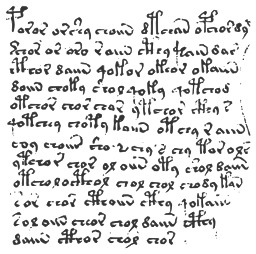
Voynich Manuscript A parchment codex, Carbon Dated to ranging between 1404 and 1438, The MS is written in an elegant, but otherwise unknown script. There are possibilities, that this is actual text, which hasn't yet been translated or deciphered, some private or imaginary language, or encrypted in some individuals code, or possibly a hoax.
Voynich Manuscript Cipher Manuscript, digitized online at Beinecke Digital Collections
Rohonc Codex, discovered in Hungary in the 1800s. It is believed to have been part of the personal library of Count Gusztáv Batthyány, before he donated his entire personal library to the Hungarian Academy of Sciences. When the Codex surfaced, it initially appeared to be from medieval times. However, the text, which appears to resemble Old Hungarian script, was completely indecipherable. Read more.

Linear A, one of only 2 Greecian scripts left to be deciphered, has been found mostly on Crete, but also at other sites in Greece, as well as Turkey and Israel.
Linear A
Linear A Lexicon
Cretan hieroglyphs, is the second of the Greek Scripts that is still undeciphered it is found on artefacts of early Bronze Age Crete, during the Minoan era. It predates Linear A by about a century, but continued to be used in parallel for most of their history. (Wikipedia)
The Cretan Hieroglyphic Texts
Mycenaean Linear B was deciphered in 1952 by Michael Ventris.
Voynich Manuscript A parchment codex, Carbon Dated to ranging between 1404 and 1438, The MS is written in an elegant, but otherwise unknown script. There are possibilities, that this is actual text, which hasn't yet been translated or deciphered, some private or imaginary language, or encrypted in some individuals code, or possibly a hoax.
Voynich Manuscript Cipher Manuscript, digitized online at Beinecke Digital Collections

Rohonc Codex, discovered in Hungary in the 1800s. It is believed to have been part of the personal library of Count Gusztáv Batthyány, before he donated his entire personal library to the Hungarian Academy of Sciences. When the Codex surfaced, it initially appeared to be from medieval times. However, the text, which appears to resemble Old Hungarian script, was completely indecipherable. Read more.

dacia.org - Scanned images of the pages
Rongorongo Glyphs of Easter Island.
The name Rongorongo comes from the Rapa Nui language, which is the native language of Easter Island, and means "to recite, to declaim, to chant out.” (Wikipedia)


